Custom PNA Syntesis

Why to use PNA as DNA mimics

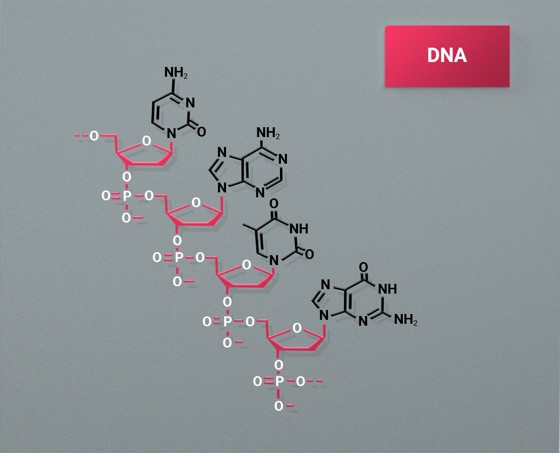
Standard PNAs are composed of acyclic, achiral, and uncharged pseudopeptide backbones, which differ significantly from conventional DNA structures in which the sugar phosphate groups are repeatedly substituted with N-(). 2-Aminoethyl)glycine units are replaced.

This unique structure gives PNAs several distinct advantages over conventional DNA and RNA molecules. One of these advantages is their remarkable chemical stability. Unlike DNA, PNA is highly resistant to enzymes such as nucleases and proteases that normally degrade DNA and RNA. This resilience gives PNAs long-term durability, which may be important in a variety of research and clinical settings.

Another important advantage of PNAs is their strong binding affinity to complementary DNA and RNA sequences. This binding occurs via standard Watson-Crick base-pairing, which allows PNAs to form highly stable duplex structures with DNA and RNA, even under conditions of low ionic strength. will be In addition, PNA-DNA and PNA-RNA duplexes are less susceptible to RNAse H cleavage, further enhancing their stability.

The neutral backbone of PNA also confers unique hybridization properties, resulting in significantly higher thermal stability compared to DNA-DNA duplexes when bound to complementary nucleic acids. This high thermal stability and lack of charge in PNAs allows for more accurate and powerful probes, improving detection and quantification of specific target sequences.

Furthermore, PNA binds to double-stranded DNA through strand invasion, breaking the DNA duplex and forming a highly stable PNA-DNA complex. This is especially useful for gene editing and targeted sequencing applications that require high sequence specificity and cannot be done with natural nucleic acid strands.

Finally, the unique biochemistry of PNAs opens up possibilities for further modifications and functionalizations such as: B. Attachment of fluorophores, quenchers, or other reporter groups. This makes it a versatile tool in the fields of diagnostics, therapeutics, and biotechnology.

In summary, PNAs are excellent alternatives to DNA and RNA in many applications due to their superior stability, strong binding affinity, high sequence specificity, and versatile adaptability. These properties make custom PNAs important players in the development of advanced techniques for nucleic acid detection and manipulation.
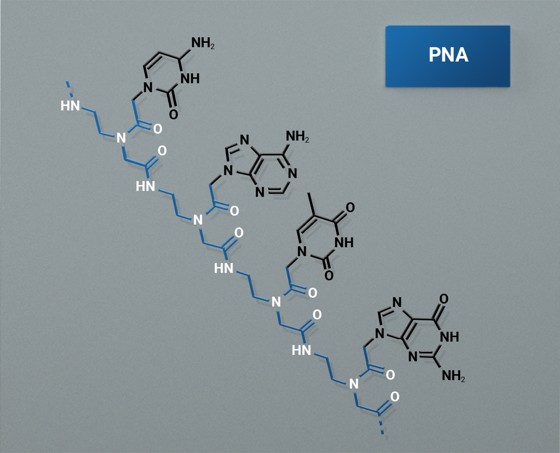
Here is the chemical structure of standard PNA oligomers
The following is the chemical structure of a DNA oligomer.

PNA Key Features

Affinity and Selectivity

The binding affinity and selectivity of PNA towards DNA, RNA is higher than for the analogous DNA duplexes due to the neutral character of PNA. PNA has better discriminating power with a more effective single base mismatch discrimination than DNA.

Stability

PNA oligomers are resistant to enzymatic degradation by proteases and nucleases, which extends their lifetime for applications in vitro and in vivo. PNAs are also stable over a wide pH range and quite stable under high temperature.

Versatility

PNA is an ideal tool in different areas of life science, such as: a) gene therapy; b) microarray screening; c) SNP (single nucleotide polymorphism) analysis; d) miRNA profiling. PNA synthesis can be carried out by conventional solid phase peptide synthesis.

DESTINA offers customized PNAs of high quality.

The DESTINA team has developed an extensive experience in PNA chemistry. Our team will design, synthesize and supply customise PNAs following strict quality control protocols to meet customer expectations. We are dedicated to delivering products that are not only reliable but also drive meaningful results in your work.

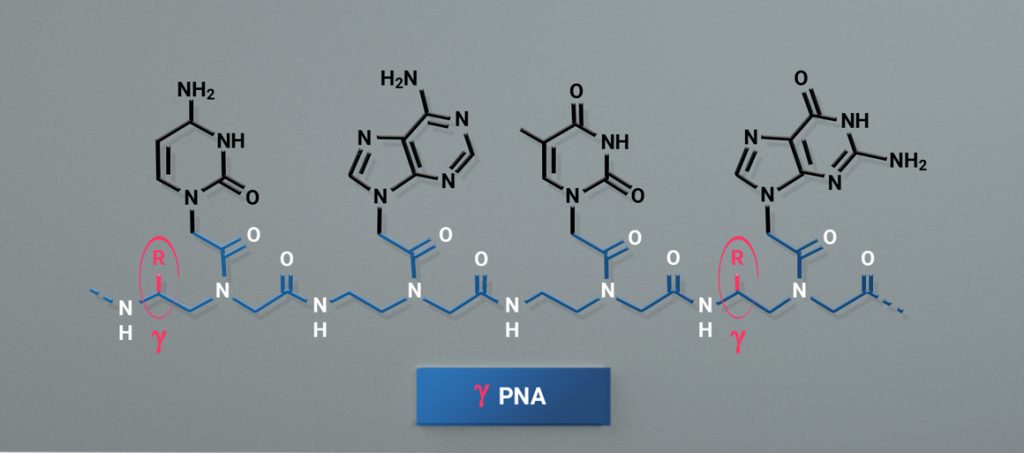
DESTINA offers standard PNA, gamma (γ)-PNA, with full support during the PNA design processes.

γ-PNA is a PNA with a side chain modification at the γ-carbon atom of the backbone. γ-PNA structure modifications provide several advantages vs standard PNA, such as improved solubility, less self-aggregation, more stable PNA-DNA duplex formation, and flexibility for multi labelling and other functionalization.

This is a visual representation of the chemical structure of gamma PNA, highlighting the location of its side chains.

PNAs are available with various modifications

Functional group

    • Amine
    • Thiol
    • Maleimide
    • Acetylation

Spacers

    • C3-NH2, C4-NH2, C6-NH2, C12-NH2
    • Polyethylene Glycol linker

γ Backbone modification

    • Lysine
    • MiniPEG
    • Glutamic acid

Peptide conjugation

    • Short peptide-conjugation: Linear synthesis on resin
    • Long peptide-conjugation: Ligation through thiol/maleimide or disulfide linkage

Fluorophore and/or Tag

    • Cyanine dye
    • FAM, FITC
    • TAMRA (TMR)
    • Biotin
    • ROX
    • TexasRed
    • ATTO dye
    • Others …

Order Details

Minimum Order Quantity (guaranteed final yield):

    • 25 nmoles for labeled PNAs
    • 50 nmoles for unlabeled PNAs

HPLC Purification:

    • Standard Purity: >90% (higher purity is available on request).

If the request you want is not listed above, please contact us, we will try our best to meet your needs.

Place an Order

To place an order of a custom PNA synthesis, please follow the link below