
The Power Behind PCR-Free Diagnostics
Our platform-agnostic chemistry transforms standard immunoassay platforms into high-value workstations. By enabling direct, extraction-free detection of miRNAs, isomiRs, and proteins on any reader, Destina Chemistry provides the bridge between proteomics and the future of RNA therapeutics.
Key Values
Click on each badge to explore our value propositions.
Destina Chemistry (DGL-Tech): The Core Chemistry
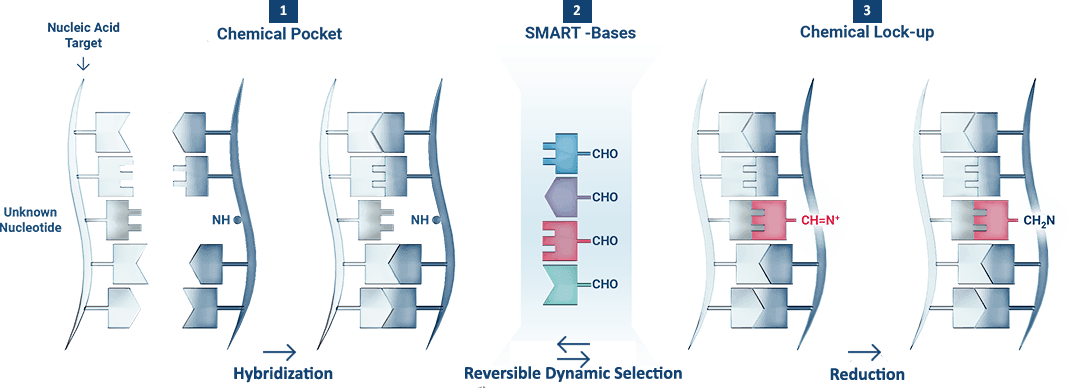
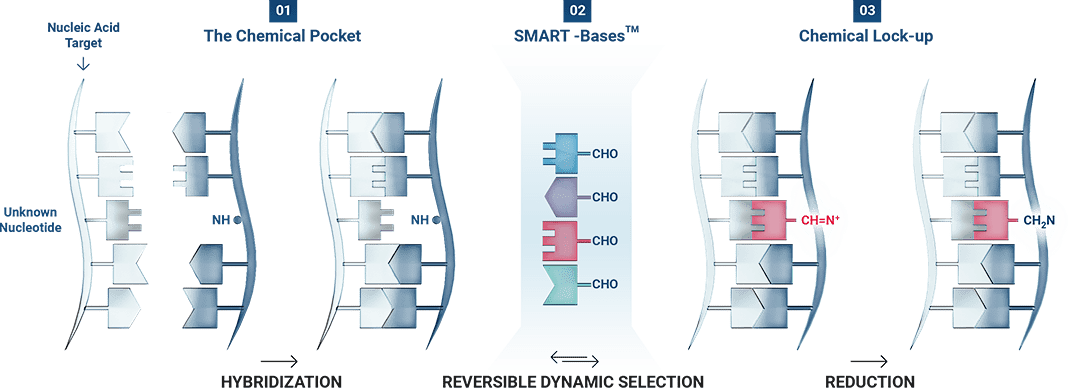
DGL-Tech for nucleic acid analysis combines patented SMART-Bases with unique peptide nucleic acid (PNA) capture probes with ‘blank’ positions (DGL-Probes).
The revolutionary DGL-Tech works thanks to Watson-Crick base pairing (C-G/A-T) that enables the templating of a dynamic reaction on the DGL-Probe.
ChemiRNA Tech: The miRNA Application
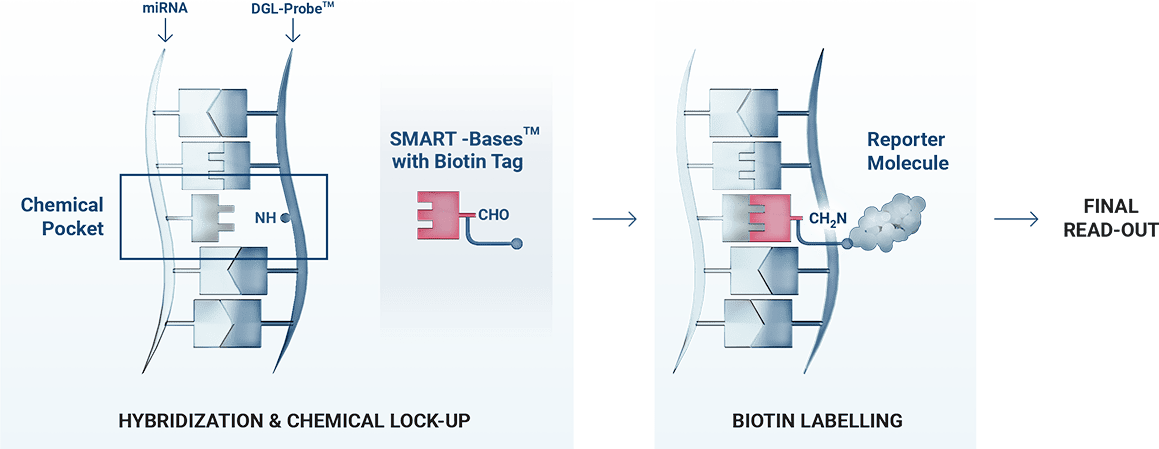
Profiling of miRNAs is one of the most active areas of research in the field of liquid biopsy. DESTINA offers a new way to interrogate sequences of miRNAs through its unique ChemiRNA Tech.
ChemiRNA Tech is based on DESTINA DGL-Tech for the direct detection and quantification of miRNAs in body fluids. It uses a single biotinylated SMART-Base to label the duplex formation with miRNA sequences.
The technology includes DESTINA proprietary Stabiltech buffer that allows the liberation and stabilisation of RNAs in body fluids, and at the same time removes the need for refrigerated handling up to the analysis.
Get Started with Destina Chemistry
We are seeking strategic partners to deploy our validated technology. Stop competing on standard assays and start offering exclusive, high-value diagnostics.
For Researchers (Pharma/Biotech)
See this technology in action. Test our validated, ready-to-use LiverAce™ Kits for DILI safety assessment today.
For Partners (CROs/Diagnostics)
License our Destina Chemistry to create your own novel, PCR-Free assays. Gain a competitive advantage in the biomarker market.
Let's Change the Future of Nucleic Acid Diagnostics
Contact Destina today to discuss licensing or partnership opportunities and gain a definitive competitive advantage in the biomarker market.
Schedule a Partnership Call